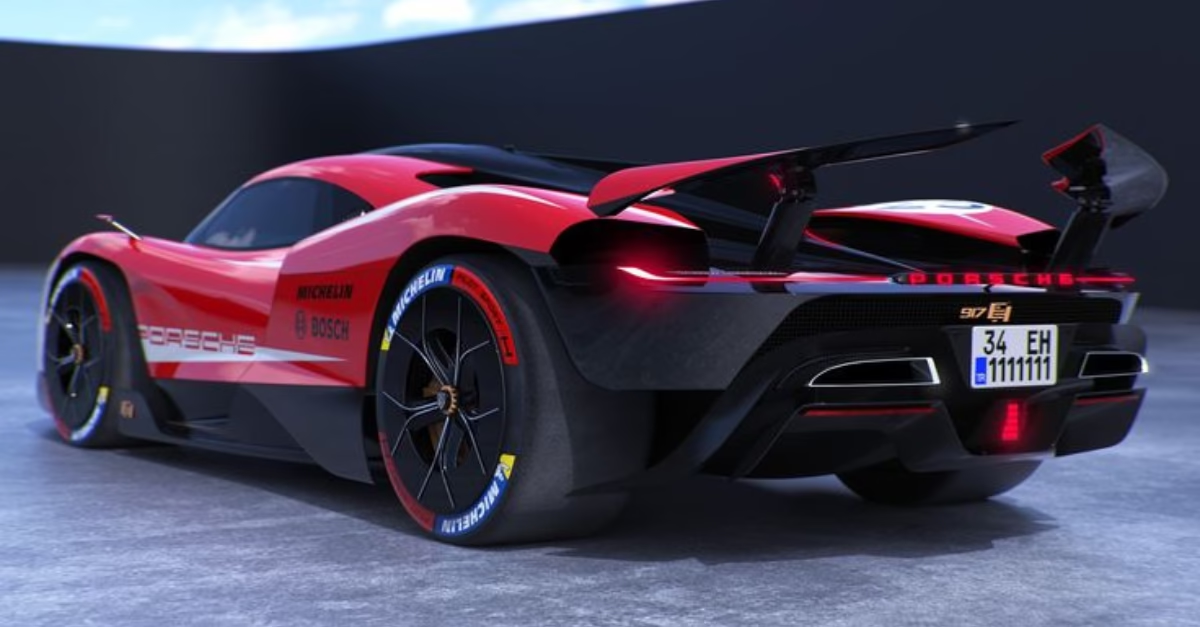
In the pantheon of motorsport legends, few names resonate as profoundly as the Porsche 917. This extraordinary racing machine didn’t just win races—it redefined what was possible in endurance racing, established Porsche as a dominant force at Le Mans, and ultimately became so powerful it was legislated out of multiple racing series. The story of the Porsche 917 is one of ambition, innovation, triumph, and the relentless pursuit of speed that continues to inspire automotive enthusiasts more than five decades after its debut.
Article Features:
- Birth and development (1968-1969)
- Revolutionary flat-12 engine details
- Early struggles and aerodynamic issues
- 917K breakthrough and redesign
- Le Mans victories (1970, 1971)
- Pink Pig variant
- Can-Am domination (917/10 and 917/30 with 1,100+ hp)
- Steve McQueen and “Le Mans” movie connection
- Jerry Seinfeld ownership
- Technical specifications and variants
- Cultural impact and legacy
The Birth of the Porsche 917
The genesis of the Porsche 917 began with frustration and opportunity in equal measure. In 1967, following a Le Mans 24 Hours that saw speeds exceeding 230 mph down the Mulsanne Straight, the FIA announced drastic regulations for 1968. The unlimited-capacity Group 6 prototypes that had dominated endurance racing would be restricted to just three liters, seemingly designed to favor Porsche’s smaller displacement approach over the massive seven-liter Ford GT40s and Ferrari prototypes.
However, there was a loophole. The existing Group 4 Sports Car category, which required homologation of 50 units, allowed engines up to five liters in displacement. While Ferrari and Ford retreated from the World Sportscar Championship in protest, Ferdinand Piëch, Porsche’s 31-year-old Head of Development and grandson of Ferdinand Porsche, saw an extraordinary opportunity. He envisioned creating the most powerful and dominant sports racing car ever built, regardless of cost.
Starting in July 1968, Porsche embarked on an intensive, secretive development program to create the Porsche 917. The project was audacious in its scope and timeline. Based loosely on the successful Porsche 908, the new car would feature an entirely new flat-12 engine designed by legendary engineer Hans Mezger, an ultra-lightweight aluminum spaceframe chassis penned by Helmuth Bott, and aerodynamics pushing the boundaries of late-1960s knowledge. The goal was singular: win Porsche’s first overall victory at the 24 Hours of Le Mans on June 14, 1970.
In just ten months, Porsche designed, developed, and built 25 complete Porsche 917 examples required for FIA homologation. When inspectors arrived at the Stuttgart factory in March 1969, they were presented with what appeared to be 25 finished cars, though in reality, only a handful were actually complete with the remainder in various stages of assembly. The inspectors initially refused homologation, demanding to see 25 fully assembled and working cars. Porsche scrambled to complete enough vehicles to satisfy the requirements, ultimately succeeding in homologating the Porsche 917 for competition.
The Revolutionary Flat-12 Engine
At the heart of the Porsche 917 beat Hans Mezger’s masterpiece: the Type 912 flat-12 engine. This air-cooled powerplant represented a quantum leap in racing engine technology for Porsche. The design essentially took the proven 908’s flat-8 configuration and added four cylinders, creating a 4.5-liter twelve-cylinder engine that initially produced around 520 horsepower and 375 pound-feet of torque.

The engine’s flat-12 configuration, sometimes incorrectly called a 180-degree V12, featured two banks of six cylinders sharing crankshaft journals—a design different from a true boxer engine where each piston has its own crankshaft throw. This configuration allowed for a low center of gravity and excellent packaging in the Porsche 917‘s mid-engine layout. The engine featured titanium connecting rods, magnesium crankcases, and sophisticated Kugelfischer mechanical fuel injection, representing cutting-edge motorsport technology of the era.
Over the Porsche 917‘s competition life, the engine underwent continuous development. By 1970, displacement had grown to 4.9 liters, producing approximately 600 horsepower. The definitive 1971 specification reached 5.0 liters with 630 horsepower at 8,300 rpm and 435 pound-feet of torque. This naturally aspirated power output was astonishing for the era, giving the Porsche 917 performance that few vehicles could match even today.

Early Struggles: Taming the Beast
When the Porsche 917 made its competition debut at the 1000km of Spa in May 1969, it immediately demonstrated blistering straight-line speed. Jo Siffert qualified on pole position, showcasing the car’s incredible potential. However, tellingly, Siffert chose to race the older, proven 908 longtail instead. The reason became clear throughout that first season: the Porsche 917 was nearly undriveable at high speeds.
The aerodynamic package, designed for minimal drag to achieve maximum velocity on Le Mans’ long straights, generated significant aerodynamic lift rather than downforce. At speeds exceeding 200 mph, the Porsche 917 would wander across the track unpredictably, requiring drivers to make constant corrections. Factory driver Brian Redman famously recalled the original car as incredibly unstable, using all the road at speed. At the 1969 Le Mans test, the handling problems were so severe that drivers reported the car becoming airborne over the Mulsanne’s crests.
The Porsche 917 struggled throughout its debut season, winning just a single race: the Zeltweg 1000km in Austria, where Jo Siffert and Kurt Ahrens Jr. combined their talents to secure the victory. More often, the car retired with handling-related incidents or mechanical failures. By season’s end, the Porsche 917 had proven fast but dangerously unpredictable, threatening to become an expensive failure rather than the championship-winning machine Piëch had envisioned.
The Breakthrough: 917K and Aerodynamic Revolution
Following the disappointing 1969 season, Porsche conducted intensive testing at the Österreichring in Zeltweg during October. Working alongside John Wyer’s Gulf-sponsored JW Automotive Engineering team, which would campaign factory-backed Porsche 917 entries for 1970, engineers made a crucial observation. John Horsman, JWAE’s Chief Engineer, famously noted the lack of dead insects on the car’s tail surfaces—indicating insufficient airflow and downforce.
The solution was radical. The Porsche 917 received a completely redesigned rear section featuring a shorter tail with a distinctive upward sweep, creating an aluminum wedge that dramatically increased downforce. This configuration became known as the 917K, with “K” standing for “Kurzheck” or “short-tail” in German. The front received enlarged cooling ducts and revised fender vents for improved brake cooling. The exhaust system was completely rerouted from side exits to outlets behind the rear wheels in new side pods.
Testing at Daytona in November 1969 confirmed the transformation. The Porsche 917K was suddenly stable, predictable, and faster through corners despite slightly reduced top speed compared to the longtail variants. Lap times improved by five seconds, an eternity in racing terms. The car was finally ready to fulfill its destiny.
Domination: The 1970 and 1971 Seasons
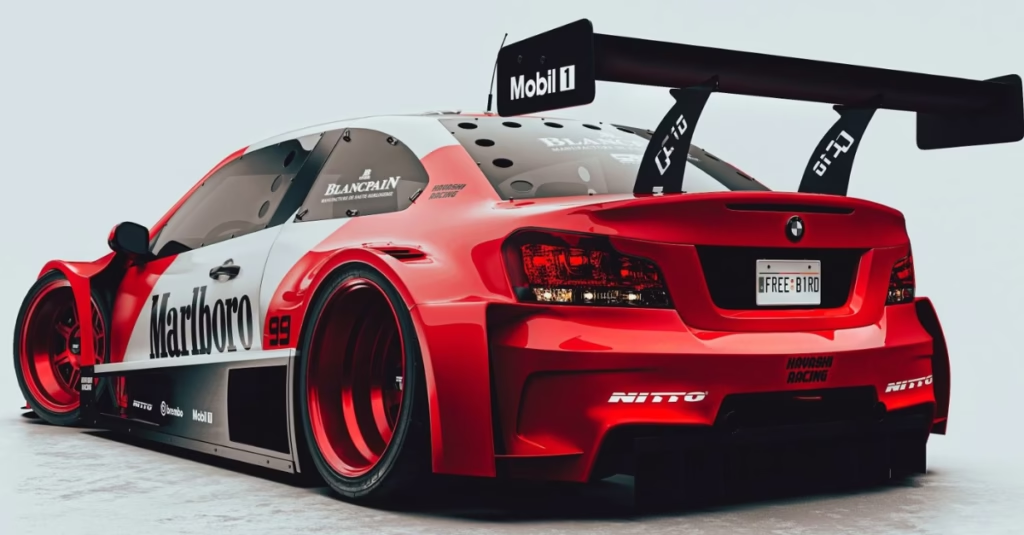
The Porsche 917 arrived at the 1970 24 Hours of Daytona as a completely different machine. The race weekend introduced the world to what would become one of racing’s most iconic liveries: the Gulf Oil blue and orange colors adorning the JWAE entries. The 917Ks dominated the race, with Pedro Rodríguez and Leo Kinnunen taking victory and announcing the Porsche 917‘s arrival as the car to beat.

The 1970 World Sportscar Championship season witnessed unprecedented domination. The Porsche 917, campaigned by both JW Automotive’s Gulf-liveried entries and Porsche Salzburg’s red-and-white cars, won nine of ten championship races. At Sebring, Brands Hatch, Monza, Spa-Francorchamps, and circuits across Europe, the Porsche 917 proved nearly unbeatable.
The crowning achievement came on June 14, 1970, at Le Mans. In torrential rain that turned the Circuit de la Sarthe into a treacherous river, Hans Herrmann and Richard Attwood drove their red-and-white Porsche Salzburg 917K number 23 to victory, covering 343 laps and 4,607 kilometers over 24 hours. Porsche had finally achieved its long-sought overall victory at the world’s most prestigious endurance race. A second Porsche 917 finished second, completing a dominant 1-2 finish.
The 1971 season saw continued Porsche 917 supremacy. Again winning seven of eight championship races, the car established complete dominance. At Le Mans, Helmut Marko and Gijs van Lennep drove their magnesium-framed 917K number 22 to victory, setting a distance record of 5,335 kilometers (397 laps) that would stand for nearly 40 years until broken in 2010. The Porsche 917 had become the most successful endurance racing car of its generation.
The Pink Pig and Experimental Variants
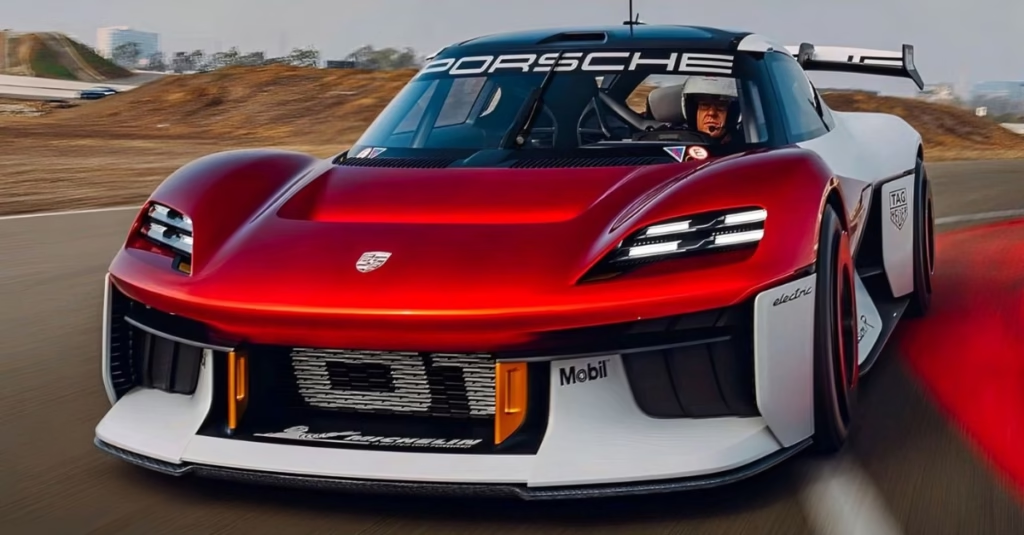
Among the various Porsche 917 configurations, one stands out for its unforgettable appearance: chassis 917/20, nicknamed the “Pink Pig” or “Sau” (German for sow). This unique experimental car, prepared for the 1971 Le Mans race, featured dramatically widened bodywork that blended elements of both the 917K and 917LH configurations, creating a bulbous, organic shape unlike any other racer.
To emphasize its rotund appearance, the 917/20 was painted in bright pink with butcher’s diagram markings labeling different sections of the car in German. This audacious livery made the “Pink Pig” Porsche 917 instantly memorable. While the car retired from the race with transmission issues, it achieved immortality as one of the most distinctive and beloved racing liveries ever created. Today, the Pink Pig aesthetic continues to inspire Porsche special editions and tribute liveries.
Can-Am Domination: The Twin-Turbo 917/10 and 917/30
Following the FIA’s 1972 regulation changes that limited World Sportscar Championship engines to three liters, effectively outlawing the five-liter Porsche 917, the company turned its attention to North America’s Canadian-American Challenge Cup, commonly known as Can-Am. This series permitted virtually unlimited engine sizes and turbocharging, providing the perfect venue for the Porsche 917‘s evolution.
The Porsche 917/10 adapted the naturally aspirated five-liter flat-12 with twin turbochargers, producing approximately 850 horsepower. Roger Penske’s team, sponsored by L&M Cigarettes and later Sunoco, campaigned these cars with tremendous success. In 1972, George Follmer won the Can-Am championship after primary driver Mark Donohue suffered injuries in testing, breaking McLaren’s five-year stranglehold on the series.

For 1973, Porsche unleashed the ultimate evolution: the Porsche 917/30. This final iteration featured a bored-out 5.4-liter twin-turbocharged flat-12 producing 1,100 horsepower in race trim with 1.3 bar of boost pressure. In qualifying specification with nearly 2.0 bar of boost, the engine could generate over 1,500 horsepower—power figures that remain staggering even by modern standards.
The 917/30‘s performance was otherworldly. It could sprint from 0-60 mph in 2.1 seconds, reach 100 mph in 3.9 seconds, and hit 200 mph in approximately 13.4 seconds. Top speed exceeded 240 mph. Mark Donohue famously quipped that the 917/30 was “the only car I’ve ever driven that can spin the tires at 200 mph.” The car’s power-to-weight ratio and acceleration surpassed virtually anything else on wheels.
Donohue and the 917/30 dominated the 1973 Can-Am season with absolute authority, winning six of eight races. The two races Donohue didn’t win were claimed by the older 917/10, making it a complete Porsche whitewash. The 917/30‘s performance was so overwhelming that it essentially killed Can-Am’s popularity, as spectators grew bored watching Porsche win every race by massive margins.
On August 9, 1975, Porsche and Penske gave the 917/30 its final official send-off at Talladega Superspeedway. With Mark Donohue driving, the 917/30 set a closed-circuit FIA speed record of 221.16 mph, a mark that stood until 1980. Tragically, this would be Donohue’s last major accomplishment; he died in a racing accident at the Austrian Grand Prix just one week later.
The Steve McQueen Connection and Cultural Impact
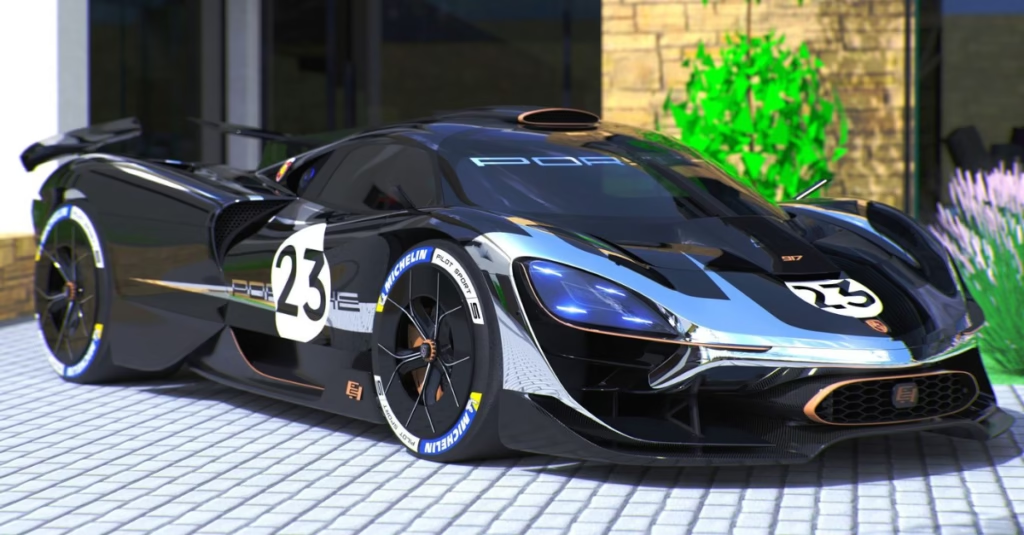
Beyond its racing achievements, the Porsche 917 achieved enduring cultural significance through cinema. Steve McQueen, already an international film star and passionate racing driver, conceived an ambitious project: a realistic film capturing the essence of endurance racing at Le Mans. His production company, Solar Productions, purchased Porsche 917K chassis 022 specifically for the 1971 film “Le Mans.”
McQueen had initially planned to actually compete in the 1970 24 Hours of Le Mans driving the 917K alongside legendary driver Jackie Stewart. However, Cinema Center Films, the production company funding the movie, vetoed this plan as too risky. Instead, McQueen focused on creating the most authentic racing film ever made, hiring 56 professional drivers, assembling 25 of the world’s fastest race cars including multiple Porsche 917 examples, and filming during the actual 1970 Le Mans race with 45 camera operators positioned around the circuit.
The Porsche 917 chassis 022 starred as McQueen’s character Michael Delaney’s car, initially appearing in the iconic Gulf Oil blue and orange No. 20 livery before reportedly being repainted as No. 21 later in filming. McQueen performed his own stunt driving in the 917, with cameras mounted directly to the car’s framework to capture visceral in-car footage that remains breathtaking today.

While “Le Mans” initially disappointed at the box office and cost McQueen his marriage and production company, it became a cult classic beloved by racing enthusiasts. The film’s documentary-style approach, focusing intently on the sights and sounds of the Porsche 917 and Ferrari 512 rather than traditional plot and dialogue, created the most authentic depiction of endurance racing ever committed to film.
After filming concluded, Porsche 917 chassis 022 enjoyed a successful racing career with various owners including Reinhold Joest and legendary driver Jo Siffert, who drove it to second place at the GP Repubblica Vallelunga and fourth at Spa’s 1000km race. Later owners included Porsche factory drivers Brian Redman and Richard Attwood, the latter having won the 1970 Le Mans race in a different 917K.
The car’s celebrity ownership continued when comedian and Porsche collector Jerry Seinfeld purchased chassis 022 in 2001. Recently restored to its original screen-used Gulf livery specification by Cavaglieri Restorations, the 917 appeared at prestigious events including Pebble Beach Concours d’Elegance and Rennsport Reunion. In January 2025, the car returned to auction at Mecum’s Kissimmee event, with expectations of potentially exceeding $20 million given its provenance as the hero car driven by McQueen. Another 917K from the film had sold for $14 million in 2017.
Technical Specifications and Variants
Throughout its production run from 1969 to 1973, a total of 59 Porsche 917 examples were built, comprising 43 naturally aspirated cars and 16 turbocharged variants. At least 11 distinct versions existed, each optimized for specific racing conditions.
The 917K short-tail coupes formed the backbone of the racing program, with 36 examples built. These featured the characteristic wedge-shaped rear end that solved the original car’s stability issues. The 917LH longtail variants, of which five were produced, prioritized minimal drag for circuits like Le Mans with long straightaways, though they sacrificed some cornering stability for higher top speeds reaching nearly 240 mph.
Open-top spyder variants were also created, including two 917PA examples for Can-Am racing. The turbocharged 917/10 series comprised 13 chassis built for the 1972-73 Can-Am seasons, while only three examples of the ultimate 917/30 specification were constructed.
Technical specifications varied by version, but the definitive 1971 917K featured the 5.0-liter flat-12 producing 630 horsepower, a four-speed manual transmission, magnesium or aluminum spaceframe construction, and a dry weight of approximately 800-820 kilograms. The 917/30 Can-Am variant weighed slightly more at around 800-850 kilograms despite its more powerful drivetrain, with the turbocharged 5.4-liter engine’s 1,100+ horsepower creating a power-to-weight ratio unprecedented in motorsport.

Legacy and Lasting Impact
The Porsche 917‘s impact on motorsport and automotive culture extends far beyond its competitive achievements. It established Porsche as a manufacturer capable of overall victories at Le Mans rather than just class wins, fundamentally changing the brand’s reputation and trajectory. The car’s success proved that calculated engineering and continuous development could overcome early struggles to achieve dominance.
The 917 influenced Porsche’s philosophy for decades, demonstrating that the company could compete with—and defeat—manufacturers with far larger budgets and resources. Lessons learned from the 917 program informed subsequent Porsche racing efforts, from the 956/962 Group C cars that dominated the 1980s to the contemporary 963 LMDh racer competing in today’s World Endurance Championship.
In collector markets, Porsche 917 examples rank among the most valuable and desirable racing cars ever created. Values regularly exceed $10 million, with the most significant examples commanding $14-20 million or more at auction. Museums around the world, including the Porsche Museum in Stuttgart, proudly display various 917 chassis in different liveries, preserving these magnificent machines for future generations.
Conclusion: The Ultimate Racing Legend
More than 50 years after its troubled debut, the Porsche 917 remains the definitive sports racing car of its era and one of the most significant competition vehicles ever created. From its genesis as Ferdinand Piëch’s ambitious project to its evolution into an unstoppable racing weapon, from Le Mans victories to Can-Am domination, from Steve McQueen’s cinematic immortalization to its continuing influence on modern motorsport, the 917 represents racing at its purest and most spectacular.
The Porsche 917 didn’t just win races—it rewrote record books, captured imaginations, and proved that engineering excellence combined with determination could overcome any obstacle. It gave Porsche its first Le Mans overall victory and established the foundation for 18 subsequent wins at La Sarthe. It dominated multiple championships so thoroughly that regulations were changed specifically to stop it. And it became so powerful that even today, modern supercars struggle to match the raw acceleration of the 917/30 Can-Am variant.
For enthusiasts, historians, and anyone who appreciates automotive excellence, the Porsche 917 represents something transcendent: a machine that exists at the absolute pinnacle of what internal combustion racing cars could achieve. Its legacy continues inspiring new generations, reminding us of an era when racing pushed boundaries without limitation, when manufacturers built cars not just to win but to dominate, and when a single vehicle could capture the world’s imagination so completely that its legend grows stronger with each passing year.
The Porsche 917 isn’t just a racing car—it’s a testament to human ambition, engineering brilliance, and the endless pursuit of speed that defines motorsport at its finest.